The underused 1♦ response
Recently, I have been working on 5-card major bidding systems:
These systems somehow work on the same problem. As Richard Granville puts it, “the 1♦ response to 1♣ is severely underused.” Each system hands 1♦ a new job, and the job decides how strong 1♣ can be.
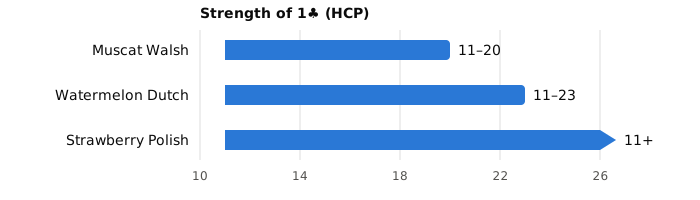
Transfer Walsh rearranges responses to a natural 1♣—1♦ for hearts, 1♥ for spades, and 1♠ for hands without a 4-card major. The 1♠ response needs some points (about 4+) so that an 18–20 opener can bid beyond 1NT and land on 2NT. The ceiling of 1♣ is roughly the same as in plain 2/1 because we still pass 3-counts, especially those without a 4-card major.
Polish Club takes the most radical way. The 1♣ opening is home to all strong hands, where 1♣ - 1♦ serves as a negative relay. The 2♣ opening is freed up for preemptive uses.
Dutch Doubleton is a lawyer’s Polish Club with a quasi-natural 1♣. Since 1♣ can hold 21–23, responder passes only a 0–5 hand with 4–5 clubs, a hand that cannot survive 1NT anyway. Every other weak hand goes through 1♣ - 1♦, a negative relay to park it. Otherwise a 3-count would respond 1♠ and push an 18–20 opener past 1NT.
The real lever is how often responder passes. The fewer hands pass 1♣, the more 1♣ can hold, and vice versa. Walsh still passes weak hands, so 1♣ keeps a natural-ish ceiling. Dutch Doubleton passes only a sliver of hands, with 1♦ as the parking spot for the rest, so 1♣ reaches 23. Polish Club never passes 1♣, so 1♣ has no ceiling at all and contains all strong hands.